
Module 1 - Introduction
Overview | STELAR, NSF & ITEST | Logistics | Plan | Proposal Steps | Resources
Logistics
Planning a successful proposal involves selecting the type of project that matches your goals, reviewing the key online resources, identifying funding opportunities, and making a successful pitch to a program officer. Along the way, it is important to build connections with colleagues and to obtain feedback on your initial ideas and writing.
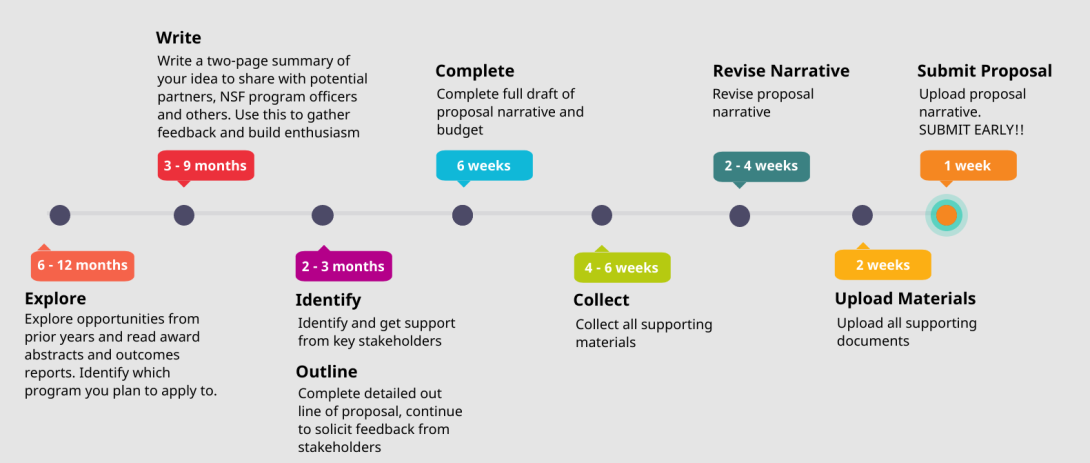
- Planning ahead is critical to completing the multiple components of a successful proposal. You will want to develop a detailed timeline to keep you and your team on track. Scroll down to see an example of a high-level timeline.
- After reviewing the timeline, review the sections below it to get a better sense of how to plan a successful proposal.
Proposal Timeline
The Proposal & Award Policies & Procedures Guide (PAPPG)
The first step in NSF proposal development is to review the Proposal and Award Policies & Procedures Guide (PAPPG). At more than 200 pages, the PAPPG includes information on all aspects of NSF grants from proposal through award. While you should familiarize yourself with the entire PAPPG over time, there are a few sections that are particularly relevant while writing a proposal. (NSF provides the PAPPG in both PDF and HTML.)
As we stated above, many of these sections will be covered in other modules, but as there is work to be done in gathering the required information for each part, it is important to understand what you must collect from whom before you begin the uploading process.
In short—do not wait until the last minute on these items!
- Take an extra moment to review the information above, to understand which items will be uploaded as separate documents and which must be entered as a form.
- Setting up a new Research.gov account can take some time; we recommend that you go to the site linked below to see if your organization already has an account. If you don’t already have an account, the page will direct you to the new account registration page.
Please keep in mind that the PAPPG is a generic guide for NSF proposal development. Before preparing your proposal you also must read your program solicitation carefully to find those places where instructions in the program solicitation differ from the guidelines provided in the PAPPG.
lease keep in mind that the PAPPG is a generic guide for NSF proposal development. Before preparing your proposal you also must read your program solicitation carefully to find those places where instructions in the program solicitation differ from the guidelines provided in the PAPPG.
ITEST solicitation
In the ITEST section we have provided a general description of the ITEST program; here we provide a brief summary of key aspects of the ITEST solicitation, which gives a detailed description of the specific components of projects the program will fund in that year. You should read the full solicitation carefully, and compare it to what you have read in the PAPPG.
Proposals must address three components to meet ITEST program goals, also known as the ITEST Pillars.
Proposed ITEST projects are expected to (1) engage students in technology-rich learning to develop disciplinary and/or transdisciplinary STEM content knowledge, including skills in data literacy and evidence-based decision-making and reasoning; (2) prioritize the full inclusion of groups who have been underrepresented and/or underserved, including but not limited to Blacks and African Americans, Alaska Natives, Hispanics and Latinos, Native Americans, Native Hawaiians, Native Pacific Islanders, persons with disabilities, neurodiverse students, and women in the STEM/ICT workforce; (3) motivate students to pursue appropriate education pathways to technology-rich careers; and (4) leverage strategic and community partnerships to expand education pathways in communities through public and private partnerships and collaborations.
See Section A of the Program Description section in the ITEST Solicitation for information about these components, including essential details to include in your proposal.
The ITEST Program supports three types of research and development (R&D) projects:
Exploring Theory and Design Principles (ETD). ETD projects describe and explore extant conditions and factors in the field intended to increase students' (and educators’) STEM knowledge and motivation, participation, persistence, confidence, and resilience in STEM and ICT fields. ETD studies build core knowledge, interrelated theory, design principles and methods. Successful ETD proposals demonstrate strong potential to yield a preliminary theoretical framework, prototype or design principles, methods or features that increase STEM knowledge, and knowledge and interest in STEM and ICT careers among PreK-12 students in formal and informal settings, particularly students from underserved and/or underrepresented populations. This project type is appropriate for projects in the conceptualization and planning phase with the goal of developing proof of concept. Up to three years, up to $500,000
Developing and Testing Innovations (DTI). Developing and Testing Innovations (DTI). DTI projects draw on existing theory and evidence to design and iteratively develop interventions, including testing individual intervention components, to provide feedback in the development process. DTI proposals involve designing a theoretically driven innovation, pilot-testing or implementing the innovation, and analyzing its outcomes. DTI studies focus on direct engagement with students and educators and assessment of student outcomes relevant to ITEST’s primary goals of increasing student knowledge of, and interest in STEM and ICT careers, as well as the development of STEM/ICT knowledge and skills required for pursuit of those careers. Results from DTI studies should inform the project’s guiding theory of change and may lead to additional work to better understand the guiding theory. DTI projects may also indicate that the intervention is sufficiently promising to warrant large-scale testing, and expansion or iteration of innovations. DTI projects must be clear on the guiding theory of change, logic model, or other rationale for the relationship between its proposed activities and anticipated outcomes. DTI implementation involves all students in underserved and or underrepresented student populations in PreK-12 formal or informal settings. Research on implementation should explicitly attend to the ways in which the design principles or features of the innovation capitalize on the strengths and challenges that participating student populations bring to the learning environments and how the design principles or project features are expected to influence student knowledge of and interest in STEM and ICT careers. Up to four years, up to $1,300,000
Scaling, Expanding, and Iterating Innovations (SEI). SEI studies are designed to build on and expand an existing innovation that has evidence of success (including DTI projects or similar innovations previously developed within or outside of the ITEST portfolio). SEI projects (a) broaden the implementation and research of an innovation at a significant scale of five to ten times greater than the original implementation; (b) extend an innovation to different student populations, regions of the country, grade levels or ages of students with varying skills, and educators' capacities in PreK-12 formal and informal settings; (c) examine issues of transferability and generalizability and the factors that support or inhibit scaling; and (d) assess cognitive and social-emotional student outcomes and measure student STEM knowledge and whether students continue to pursue further STEM and ICT education or careers.
Up to five years, up to $3,500,000.
NSF ITEST Solicitation 22-585
All ITEST projects are research and development projects. This means that research is a critical component of a successful proposal. We discuss this in more detail in the Research Module.
- Familiarize yourself with the current ITEST solicitation. We refer to the solicitation throughout the course, and by the end of the course you will have read through the solicitation multiple times.
- Visit the ITEST Program website and check out What Has Been Funded, which links to funded ITEST project abstracts.
- Visit the STELAR website, where you can view projects working in similar disciplines or settings. From the site, you can contact funded Principal Investigators to learn more