
Module 3 - Writing a Compelling Project Description
Overview | Technical | Merit & Impacts | Writing | References | Proposal Steps | Resources
Writing
By now you have reviewed the technical criteria that will guide the development of your Project Description. You have a good sense of the topics that haveto be covered (Project Overview, Rationale, and Importance; Results from Prior NSF Support; Expertise and Management; Merit Review Criteria; Solicitation-Specific Review Criteria; ITEST Pillars; High-Quality Research Plans) and the amount of space you will have to present your argument that this proposal should be funded (15-page limit, single-spaced). As other modules will cover the development of your plans for Research, Evaluation, and Dissemination, this section will focus on how to weave the information about your proposal’s rationale/needs statement, broader impacts and intellectual merit, goals/objectives/logic model, activities, and management plan into a compelling project description.
Your goal is to convince the review panel (and program officer) that your proposal focuses on an important and timely issue that is central to strengthening knowledge of and interest in STEM and ICT careers; proposes an innovative idea and builds on evidence of prior research; that your approach is based on a theory of change, grounded in research, that underpins your strategy, activities and relationships; and that your activities are well thought out, and clearly describe what you plan to do and how you will go about making sure that your project work will be successful.
Consider the following as you plan and draft each section of your Project Description. They will help you create a strong “line of argument” as to why NSF should fund this effort.
A note on editing: Be sure to carefully edit your final documents. Having a trained editor review/edit your final submission is an important step in producing a credible proposal. Be sure you set aside at least two days in your proposal development plan to send your proposal to an editor and to accept/reject changes before uploading.
Here is an example outline for your Project Description.
- Project Overview, Rationale, and Importance
- Project Goals and Objectives
- Project Activities
- ITEST Pillars
- Pillar 1. Innovative Use of Technologies in Learning and Teaching
- Pillar 2. Partnerships for Career and Workforce Preparation
- Pillar 3. Strategies for Equity in STEM Education
- Solicitation Specific Criteria
- Recruiting students from underrepresented groups
- Addressing diversity, equity, and access
- Leveraging strengths and addressing challenges
- Age-appropriate technology
- Results from Prior NSF Support
- High-Quality Research Plan
- Project Evaluation
- Dissemination
- Expertise and Management
- Intellectual Merit & Broader Impacts
Project Overview, Rationale, and Importance
The Proposal Preparation Instructions section of the ITEST Solicitation provides the following guidance on this section of your proposal:
The proposal must show how the project addresses critical STEM educational needs and the potential for intellectual merit and broader impacts within the context of the ITEST purpose. The proposal provides an overview of the project goals or objectives, and a rationale for how the work will improve knowledge of and interest in STEM/ICT career pathways for students and advance teachers’ understanding of STEM/ICT content and career pathways. The proposed work addresses how the planned STEM education innovations differ from existing practice, and why the study has the potential to improve student and educator learning and other educational outcomes beyond what current practices provide."
A strong rationale will
- Begin with a very short (one- or two-sentence) overview of the project for readers who don’t first read the Project Summary
- Include strong statements describing why this project is necessary, documented through data/prior research
- Build upon prior NSF-funded research—referencing/citing major known works, research, ideas, issues
- Describe a theory of change (that is, a description of how and why a desired change is expected to happen in a particular context) (see Module 1)
- Include a concise, in-depth review of the literature describing the theoretical grounding of your theory of change
- Include a paragraph on the Intellectual Merit of your proposed project and demonstrates that it meets the criteria (Activity 3.02a)
- Include a separate, titled paragraph describing the Broader Impacts of your proposed project and demonstrates that it meets the criteria (Activity 3.02b)
- Make a strong case that your planned activities will advance research in the field
Guided by the bullet points above, begin drafting a 1–2-page rationale that makes a strong case for funding your project idea. This draft will be used to complete the Project Overview/Rationale/Importance section of your Proposal Description in the assignment for this module.
In order to make a persuasive case for your project, your project goals/objectives/research questions should
- Flow from your Rationale as the best, logical next steps in moving the field forward
- Provide the reader with an understanding of how these project parts are connected and lead to intended outcomes
- Clearly state how your project is designed to address the ITEST Pillars (See Program Description section in the ITEST Solicitation).
- State the goals/objectives and research questions clearly (See Module 1: Introduction [Plan tab])
- Align to and include your logic model. There should be a clear connection between the project description text and the logic model (i.e., a connection between your theory of change, which provides hypotheses, and your logic model, which provides concrete steps to reach outcomes).
Note: Other sections of the Project Description, including High-Quality Plans and Dissemination, are covered in later modules.
Draft approximately one-third page on the goals and objectives of your proposed project. Review and edit your logic model template and the concept paper that you wrote in Module 1. You will then use these to complete the Goals/Objectives/Research Questions section of your Proposal Description in the assignment for this module.
Project Activities
You will describe the project activities in sufficient detail so that the reader knows that you know precisely what you intend to do, with whom, how, and by when. Specifically, it will:
- Provide further detail on the activities, outputs, and outcomes described in your logic model;
- Include a timeline of major project activities and what partner has primary responsibility for the success of each;
- Describe participants—who, how they will be recruited, criteria for selection and, if compensated, at what rates;
- Provide a high-level overview of agendas and intended outcomes of key events;
- Directly connect activities to your theory of change;
- (If providing professional development or training) describe who will provide training, when, how often, intended outcomes (what knowledge will be gained by participants/what skills developed), how feedback will be obtained and used to improve service. Identify specific pedagogical approaches selected for professional development and why they were chosen.
Draft a 1½–2-page brief but detailed overview of activities that you will engage in to fulfill the goals and objectives of your project. You can add your logic model here to clarify project activities and show their relationship to outcomes and intended impact. Use this draft to complete the Activities section of your Proposal Description in the assignment for this module.
ITEST Pillars

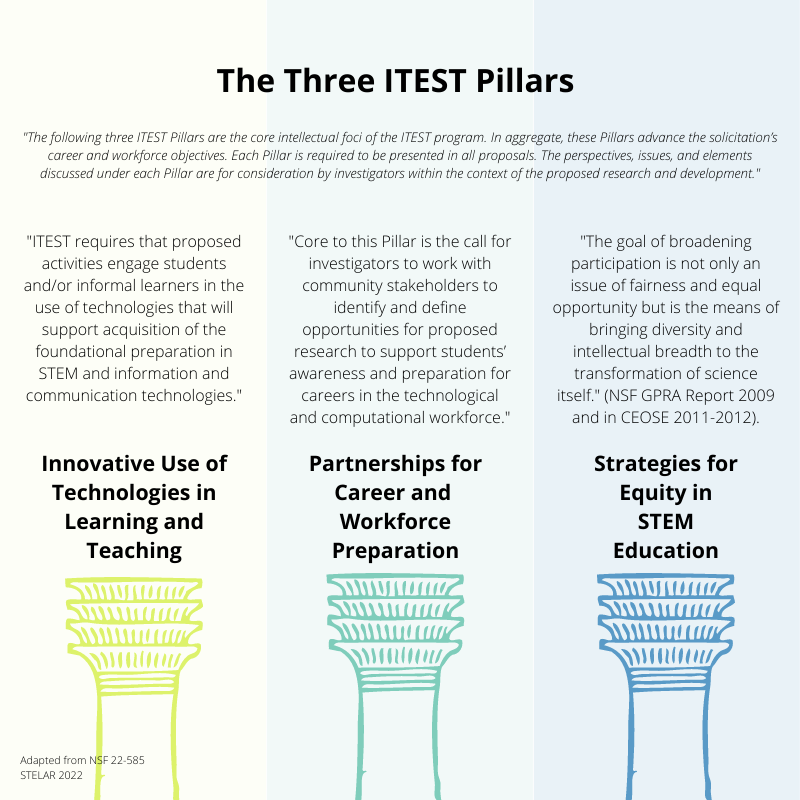
Make sure to carefully review “Section A. ITEST Pillars” (under “II. Program Description”) of the solicitation. You are required to describe how your project is designed to address all three domains toward the ultimate goal of broadening and diversifying the STEM workforce.
Three core ITEST Pillars frame the opportunities for all students to acquire the foundational preparation in fields aligned with the technological and computational workforce, including students in underserved regions and Tribal Nations where access to technology and virtual learning remains a substantial challenge."
In alignment with Pillar 3: Strategies for Equity in STEM Education, your proposal also must address the Solicitation Specific Review Criteria.
Additional Solicitation Specific Special Review Criteria
Many proposal writers overlook the solicitation specific review criteria, which is found under the Merit Review Principles and Criteria section of the solicitation. Read this section carefully! Your proposal is required to:
- Include explicit and adequate strategies for recruiting and selecting participants from populations currently underserved and underrepresented in STEM professions, careers, or education pathways
- Describe approaches to address diversity, access, equity, and inclusion in PreK-12 learning environments to ensure that all students, particularly those from underserved and underrepresented populations, actively engage with STEM disciplines and fields that stimulate effective instruction and learning.
- Describe specific research-informed instructional approaches to build on the strengths and challenges that students and their educators bring to classrooms and informal learning environments, particularly with students from underserved and underrepresented populations in STEM fields
- Explain how planned innovations with the technology are developmentally and age-appropriate for students and suited for the specific populations of students and educators from underserved and underrepresented student populations
STELAR Resource Libraries
As mentioned in the previous section, the intellectual merit of your proposal should advance the knowledge of the field. Above we discussed how the rationale section should build upon prior NSF-funded research. Finally, meeting the solicitation-specific review criteria requires a knowledge of effective strategies and approaches to working with diverse youth and communities. STELAR has two resource libraries to support you in these areas:
- Our main resource library (edc.org/resources) provides hundreds of publications, instruments and curricula developed by current and prior ITEST projects.
- Our new Diversity, Equity, Inclusion & Accessibility Resource Library (edc.org/deia-resources) offers more than 40 publications selected by five expert researchers nationally recognized for their work with diverse communities.
Searching and reviewing the content of these libraries should provide ample resources to assist in building a strong base for your project description.
Many proposal writers overlook the solicitation specific review criteria, which is found under the Merit Review Principles and Criteria section of the solicitation. Read this section carefully! Your proposal is required to:
To address the “Solicitation Specific Review Criteria” listed in the ITEST Solicitation, draft responses to the questions below . Be sure to include this in the assignment at the end of this module.
- To what extent does the proposal include explicit and adequate strategies for recruiting and selecting participants from underserved and underrepresented populations in STEM professions, careers, or education pathways?
- To what extent does the proposal describe approaches to address diversity, access, equity, and inclusion in PreK-12 learning environments to ensure that all students, particularly those from underserved and underrepresented populations, actively engage with STEM disciplines and fields that stimulate effective instruction and learning?
- To what extent does the proposal describe specific research-informed instructional approaches to build on the strengths and challenges that students and their educators bring to classrooms and informal learning environments, particularly with students from underserved and underrepresented populations in STEM fields?
- To what extent does the proposal explain how planned innovations with the technology are developmentally and age-appropriate for students and suited for the specific populations of students and educators from underserved and underrepresented student populations?
Expertise and Management Plan
Your Expertise and Management Plan will do the following:
- Describe the management structure that will be used to administer the project (role of lead organization, team meetings, expectations for reporting progress, etc.) and to communicate with partners (frequency and method of communication)
- Describe partners/institutions and the roles they will play in the proposed project
- Describe the expertise of key personnel (PI, Co-PIs, PD, Evaluator), who they are, and their primary project responsibilities
- Describe the Advisory Committee members, their affiliations, why they were selected, and their role/responsibilities for guiding project activities; as well as the process for gathering input (in-person, virtual meetings, how often, how input will be used by project leadership)
Ask your key personnel to write a short description of their expertise and primary project responsibilities.
If you do not yet have your key personnel on board, describe the individuals you are soliciting to join the project, the qualifications they have, and what their role on the project will be.
These descriptions will account for approximately ½ to ¾ of a page of the Project Description.
Results of Prior Support
For proposed PIs and Co-PIs who have received NSF support within the past 5 years, NSF requires a statement of the results of that support. This is a technical writing task. Specific instructions can be found in the PAPPG section d.iii Project Description,Results of Prior Support (see excerpt below). Note that although NSF wants specific information about the funded grant(s), their purpose is to learn what has resulted from the investment in projects the PI and Co-PIs of this proposal have led. See examples below.
Results from Prior NSF Support
Excerpts from this section are found below,;please refer to PAPPG II.D.2.d.iii (pp.12–13) for the full description.
The purpose of this section is to assist reviewers in assessing the quality of prior work conducted with prior or current NSF funding. If any PI or co-PI identified on the proposal has received prior NSF support including:
- an award with an end date in the past five years; or
- any current funding, including any no cost extensions,
information on the award is required for each PI and co-PI, regardless of whether the support was directly related to the proposal or not. In cases where the PI or any co-PI has received more than one award … they need only report on the one award that is most closely related to the proposal.
Support means salary support, as well as any other funding awarded by NSF, including research, Graduate Research Fellowship, Major Research Instrumentation, conference, equipment, travel, and center awards, etc.
The following information must be provided:
(a) the NSF award number, amount and period of support;
(b) the title of the project;
(c) a summary of the results of the completed work, including accomplishments, supported by the award. The results must be separately described under two distinct headings: Intellectual Merit and Broader Impacts;
(d) a listing of the publications resulting from the NSF award (a complete bibliographic citation for each publication must be provided either in this section or in the References Cited section of the proposal); if none, state “No publications were produced under this award.”
(e) evidence of research products and their availability, including, but not limited to: data, publications, samples, physical collections, software, and models, as described in any Data Management Plan; and
(f) if the proposal is for renewed support, a description of the relation of the completed work to the proposed work.
If the project was recently awarded and therefore no new results exist, describe the major goals and broader impacts of the project. Note that the proposal may contain up to five pages to describe the results. Results may be summarized in fewer than five pages, which would give the balance of the 15 pages for the Project Description.
Write
Draft your Results of Prior Support (as needed), taking care to stay within the 5 pages allowed. Insert these pages into the Project Description draft that you are completing for this module’s assignment.
NOTE: Other sections of the Project Description, including Dissemination, Research, and Evaluation, will be covered in later modules.